An historically significant person once wrote, “a man without a sense of history is like a man without ears or eyes”. While much of Europe maintains buildings and works hard to preserve positive elements of history, how people respond to more negative historical events is informative. Acknowledging the flaws of the past without revelling in them must sometimes be a difficult burden to bear. Australia has struggled with how to most appropriately deal with the actions of those in the past toward Aboriginal people. For the people of Germany, at whose feet are laid the blame for two World Wars and the Holocaust, the baggage must sometimes feel extraordinarily heavy.
We had intended to rise around 4am to depart by 4:30 for Stansted Airport to catch our flight.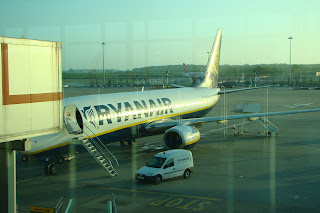 You might therefore appreciate our alarm when Meg looked at her phone at 4:37 and found that it hadn’t gone off. 11 minutes later we were throwing the last of the bags in the car and setting off for the airport, consuming breakfast as Wayne drove. Ultimately, all the connections and traffic worked in our favour and we even had time to look around the shops before being the first to board our flight to Memmingen in Germany.
£57 for the four of us to fly return to Germany was a fabulous deal. However, when you factor in that it costs an extra £20 per bag you want to check in; £4 per person to avoid the graceless swarm for seating by choosing priority boarding; the money spent on food and drink because nothing will be provided on board the flight; let alone the cost of transporting us all from Memmingen in to Munich (rather than being able to utilise the subway or the free Lufthansa run shuttle buses from the main airport), then the price looks a little different. That we discovered
  on a recent bank statement Ryanair charges a fee of £9.50 per person to use a credit card in booking (which is the only method you can use in order to get the cheapest flights) made us even more wary. Finally, that Ryanair’s owner, Michael O’Leary, decided to state that the swine flu “is only of real concern to slum-dwellers in places like Asia and Mexico”, demonstrates the attitude lying behind the airline. After our next trip (which is already booked) we will not be flying with them again.
The flight itself was relatively short (although, to Meg’s frustration, still long enough for all the males to have a nap) and we found ourselves descending upon Memmingen Airport. The countryside we were flying into was beautifully rural, at times looking like a postcard of what you might expect from an old fashioned, European, farming scene. This contrasted somewhat with the airport itself. It was quite clear that, as with our previous flight to Germany, that this airport had a history as a military base. Signs of camouflage were everywhere, from the storage bunkers built with the ground rising up and over them, to the larger buildings still with the old paintwork upon them.
Once again we met an Australian while waiting in line at Customs (people have to get their passports out which makes them much easier to spot) where the queue, even on our half empty flight, nearly went out of the building. From the look of the pipe work there are plans to expand the terminal building, although how they will do this without spoiling the integrity of the design was difficult to see. Possibly it was just that the building wasn’t quite finished. Soon enough we were through (and Quinn had a German stamp in his passport) we were outside and climbing into a taxi to take us into Memmingen itself to catch the train to our ultimate destination for this trip, Munich.
Even though we were headed to Munich, Memmingen itself has a significant place in history. It is believed that on the site of present day Memmingen during Roman times there was a small military town. In the 5th century a settlement was established and in the 7th century there was a palace belonging to the king of the Franks. While it has the official motto, Memmingen – Stadt mit Perspektiven (Memmingen – a town with perspective) in recent times it has been frequently referred to as Memmingen – Stadt der Menschenrechte (Memmingen - the town of human rights). This refers to the Twelve Articles, considered to be the first written set of human rights in Europe, which were penned in Memmingen in 1525 as part of the response to Martin Luther. Every four years there is the Wallensteinfestspiel, with about 4,500 participants, one of the biggest historical reenactments in Europe. It commemorates the invasion of Wallenstein and his troops during the 30 Years War in Europe, between Catholic and Protestant forces. It seems like a lovely town although we were only passing through.
Once on the train, even though we were now heading east (having come from the west) it felt like the countryside we were seeing through the windows was the same that we had flown over. The landscape was dotted with farmhouses that looked like they could have been hundreds of years old, tiny village churches, and people riding bicycles. As we had previously experienced, the German public transport was brilliant; clean, modern, quiet, relatively cheap (we bought a ticket that would cover the 4 of us on any public transport in the whole of Bavaria for the next 24 hours for less than €30), and on time. Although our journey took well over an hour it didn’t seem that long before we were travelling through the suburbs on the outskirts of Munich. Like cities we have been to all over the world the suburbs adjoining the railway line were not that attractive, although there were some fascinating sights (such as the multi-story car display building, where it seemed they must have lifted the Mazdas and Fords in by crane).
Munich Central train station is the transport hub of the city, with all the different types of trains, buses, and trams making their way there. In moving from one rail line to another we misunderstood where we were headed. Instead of going on to the subway, we boarded one of the suburban trains (in our defence, there are four different line types which converge on the station) and headed out to where we thought the maps indicated our hotel would be. Fortunately, Wayne was on the ball and realised our mistake and we quickly jumped off at Ostbahnhot and went down the stairs to the subway boarding the train that was waiting there back to Rosenheimer Platz. The Novotel had signage up all through the subway station and shopping area which was attached, and a short walk found us at the doorstep. We left our luggage (this early in the morning the room was not yet ready) and walked back to the subway and caught it a couple of more stops into Marienplatz, the real centre of Munich.
It was a beautiful spring day and the crowds were out. The staff at our hotel had explained that the German May Day holiday had been the day before and there were lots of visitors up in Munich for the long weekend. There was also a big football game between Bayern Munich and Borussia Mönchengladbach being played in the city that afternoon (which would attract a capacity 69 000 fans) and many of the spectators were taking the opportunity to lunch in the
  city centre before heading out to the Allianz Arena in the suburbs. Consequently, we emerged from the subway into a swarm of people milling in the pedestrian area outside the Rathaus (Town Hall). Lunch was our priority, so we wandered amongst the masses through the Beer Garden (bigger than any beer garden any of us had experienced before) around the food market and found ourselves a seat on the street called Tal.
Perhaps because it was the holidays there were all sorts of people out in, what looked to us like, costumes. We had probably all just assumed that lederhosen were the national dress but that no one wore it any more (at least not in public). How wrong we were! As we sat and ate all sorts of people walked past us wearing traditional German dress; men, women and children. We were so inspired by this that we hit upon the
  idea of buying an outfit for Brock to wear to his school Prom and had the boys pose outside one of the many shops that specialised in this sort of clothing. Strangely, Brock didn’t take to the idea as warmly as the rest of us and that, plus the price of the clothes themselves, will probably mean that he wears much less interesting clothing on the night.
We had intended to rise around 4am to depart by 4:30 for Stansted Airport to catch our flight.
 You might therefore appreciate our alarm when Meg looked at her phone at 4:37 and found that it hadn’t gone off. 11 minutes later we were throwing the last of the bags in the car and setting off for the airport, consuming breakfast as Wayne drove. Ultimately, all the connections and traffic worked in our favour and we even had time to look around the shops before being the first to board our flight to Memmingen in Germany.
£57 for the four of us to fly return to Germany was a fabulous deal. However, when you factor
 in that it costs an extra £20 per bag you want to check in; £4 per person to avoid the graceless swarm for seating by choosing priority boarding; the money spent on food and drink because nothing will be provided on board the flight; let alone the cost of transporting us all from Memmingen in to Munich (rather than being able to utilise the subway or the free Lufthansa run shuttle buses from the main airport), then the price looks a little different. That we discovered
  on a recent bank statement Ryanair charges a fee of £9.50 per person to use a credit card in booking (which is the only method you can use in order to get the cheapest flights) made us even more wary. Finally, that Ryanair’s owner, Michael O’Leary, decided to state that the swine flu “is only of real concern to slum-dwellers in places like Asia and Mexico”, demonstrates the attitude lying behind the airline. After our next trip (which is already booked) we will not be flying with them again.
The flight itself was relatively short (although, to Meg’s frustration, still long enough for all
 the males to have a nap) and we found ourselves descending upon Memmingen Airport. The countryside we were flying into was beautifully rural, at times looking like a postcard of what you might expect from an old fashioned, European, farming scene. This contrasted somewhat with the airport itself. It was quite clear that, as with our previous flight to Germany, that this airport had a history as a military base. Signs of camouflage were everywhere, from the storage bunkers built with the ground rising up and over them, to the larger buildings still with the old paintwork upon them.
Once again we met an Australian while waiting in line at Customs (people have to get their
 passports out which makes them much easier to spot) where the queue, even on our half empty flight, nearly went out of the building. From the look of the pipe work there are plans to expand the terminal building, although how they will do this without spoiling the integrity of the design was difficult to see. Possibly it was just that the building wasn’t quite finished. Soon enough we were through (and Quinn had a German stamp in his passport) we were outside and climbing into a taxi to take us into Memmingen itself to catch the train to our ultimate destination for this trip, Munich.
Even though we were headed to Munich, Memmingen itself has a significant place in history.
 It is believed that on the site of present day Memmingen during Roman times there was a small military town. In the 5th century a settlement was established and in the 7th century there was a palace belonging to the king of the Franks. While it has the official motto, Memmingen – Stadt mit Perspektiven (Memmingen – a town with perspective) in recent times it has been frequently referred to as Memmingen – Stadt der Menschenrechte (Memmingen - the town of human rights). This refers to the Twelve Articles, considered to be the first written set of human rights in Europe, which were penned in Memmingen in 1525 as part of the response to Martin Luther. Every four years there is the Wallensteinfestspiel, with about 4,500 participants, one of the biggest historical reenactments in Europe. It commemorates the invasion of Wallenstein and his troops during the 30 Years War in Europe, between Catholic and Protestant forces. It seems like a lovely town although we were only passing through.
Once on the train, even though we were now heading east (having come from the west) it felt
 like the countryside we were seeing through the windows was the same that we had flown over. The landscape was dotted with farmhouses that looked like they could have been hundreds of years old, tiny village churches, and people riding bicycles. As we had previously experienced, the German public transport was brilliant; clean, modern, quiet, relatively cheap (we bought a ticket that would cover the 4 of us on any public transport in the whole of Bavaria for the next 24 hours for less than €30), and on time. Although our journey took well over an hour it didn’t seem that long before we were travelling through the suburbs on the outskirts of Munich. Like cities we have been to all over the world the suburbs adjoining the railway line were not that attractive, although there were some fascinating sights (such as the multi-story car display building, where it seemed they must have lifted the Mazdas and Fords in by crane).
Munich Central train station is the transport hub of the city, with all the different types
 of trains, buses, and trams making their way there. In moving from one rail line to another we misunderstood where we were headed. Instead of going on to the subway, we boarded one of the suburban trains (in our defence, there are four different line types which converge on the station) and headed out to where we thought the maps indicated our hotel would be. Fortunately, Wayne was on the ball and realised our mistake and we quickly jumped off at Ostbahnhot and went down the stairs to the subway boarding the train that was waiting there back to Rosenheimer Platz. The Novotel had signage up all through the subway station and shopping area which was attached, and a short walk found us at the doorstep. We left our luggage (this early in the morning the room was not yet ready) and walked back to the subway and caught it a couple of more stops into Marienplatz, the real centre of Munich.
It was a beautiful spring day and the crowds were out. The staff
 at our hotel had explained that the German May Day holiday had been the day before and there were lots of visitors up in Munich for the long weekend. There was also a big football game between Bayern Munich and Borussia Mönchengladbach being played in the city that afternoon (which would attract a capacity 69 000 fans) and many of the spectators were taking the opportunity to lunch in the
  city centre before heading out to the Allianz Arena in the suburbs. Consequently, we emerged from the subway into a swarm of people milling in the pedestrian area outside the Rathaus (Town Hall). Lunch was our priority, so we wandered amongst the masses through the Beer Garden (bigger than any beer garden any of us had experienced before) around the food market and found ourselves a seat on the street called Tal.
Perhaps because it was the holidays there were all sorts of people out in, what looked to us like,
 costumes. We had probably all just assumed that lederhosen were the national dress but that no one wore it any more (at least not in public). How wrong we were! As we sat and ate all sorts of people walked past us wearing traditional German dress; men, women and children. We were so inspired by this that we hit upon the
  idea of buying an outfit for Brock to wear to his school Prom and had the boys pose outside one of the many shops that specialised in this sort of clothing. Strangely, Brock didn’t take to the idea as warmly as the rest of us and that, plus the price of the clothes themselves, will probably mean that he wears much less interesting clothing on the night.
The cobble-stoned streets also presented us with plenty of other amazing sights. Once again  bicycles were well in evidence, with long lines of identical looking bikes almost begging to be rented out and put through their paces. Europe is way ahead of Australia as far as embracing eco-friendly forms of transport (although one suspects that the prevalence of bicycles existed long before the term eco-friendly was even invented). Munich is a relatively flat city so it is not as difficult a form of transport to manage as it might be elsewhere. There was also an amazing motor bike, which the owner had covered in fur, with the head of a deer mounted on the back. Hunting of game has long been a popular sport in Germany, and this was a vivid reminder.
While we were sitting we also noticed a number of open topped tourist buses drive past. Part of our plan for the next two days involved catching these, much as we had done in other parts of the world, in order to facilitate some of our sight-seeing. We had grabbed some brochures at the hotel before we came into the city and were able to read
  through them and compare routes, prices, etc. This time we opted for one run by Viator which had; two different tour routes, was the type which you could hop on and off, and was much the same price as the other (which didn’t have either of those features). Fortunately, a stop was visible from our table, so we wandered across the road and boarded, finding out that it was right at the end of one of the routes, so we rode the couple of blocks back to Central Station where we needed to purchase the ticket.
The route from the station at this end of the day ran out through the north-western suburbs of Munich to Schloss Nymphenberg, a beautiful palace with even more beautiful grounds. At the front is a lake, complete with white swans, geese and ducks, fed by a series of canals which we had driven alongside on our way. Because we were going to spend more time there on the Sunday we elected not to get out (except for Wayne to take a few quick snaps) but it was already clear that this was a place that would be worth exploring.
From Nymphenberg we headed east to the site of the 1972 Munich Olympics, much of the buildings from which still stand and are used regularly. Interestingly, the foundations of the Olympic site and particularly of the amazing parklands which lie next to it were constructed from the rubble left after the destruction of much of Munich at the conclusion of World War II. A number of times over the next few days we were to
  hear how more than 80% of the buildings in Munich were damaged or destroyed and when the rebuilding began the rubble from this destruction was brought out to this site. Part of the Olympic bid was premised on making something good out of the horror of the past. This part of Munich is known as the "Oberwiesenfeld" ("upper meadow-field"), and the Park continues to serve as a venue for cultural, social, and religious events such as events of worship.
Also out in this area (across the highway from the main Olympic Stadium in fact) is the huge BMW Complex which includes their corporate headquarters and the colossal BMW museum which looks at the creation of BMW engines, their use in all sorts of machinery, including aeroplanes and racing cars, and a history of the corporation. Those of you who are particularly wealthy can visit there and, apparently, order a car and have it delivered to the front door at the end of your visit. It all looks very impressive and, should we have had time, the boys and Wayne would have enjoyed the opportunity to take a look inside.
Back across the walkway which spans the Georg-Brauchle-Ring our tour paused so that we could take a better look at both the main stadium roof. This included large sweeping canopies of acrylic glass stabilized by steel cables that were used for the first time in a large scale. The idea was to imitate the Alps and the effect is certainly striking and readily visible from a considerable distance. Following the Olympics, the stadium
  became the home of FC Bayern München, with their cross town rivals TSV 1860 München moving in during the 1990s. It was only in 2005 that both moved out to the purpose built Allianz Arena. For Wayne one of the exciting things about this stadium was that it was the venue for the 1979 European Cup final, which saw Nottingham Forest winning the trophy against Malmö FF (from Sweden) 1-0.
Another impressive piece of architecture is the Olympiaturm, a tower which is somewhat reminiscent of Black Mountain Tower in Canberra, Australia. The Olympiaturm has an overall height of 291 m (making it almost 100 metres taller than Black Mountain) and a weight of 52,500 tonnes. At a height of 190 m there is an observation platform as well as a small rock and roll museum housing various memorabilia. Since its opening in 1968 the tower has registered over 35 million visitors (as of 2004). The tower also contains a revolving restaurant, seating 230 people, which completes a full revolution in 53 minutes. In the visitor lift to the top of the tower the travel time is about 30 seconds. Because of the general flatness of the landscape of Munich itself, views from the top are said to be spectacular, once again this is an example of us finding interesting places that we will have to revisit in order to experience.
It has been said in a number of places that for a substantial time after the war the people of Germany seemed to suffer from ‘collective amnesia’. Given the actual events that many of them experienced, as well as the revelations that came out of Auschwitz etc. this seems a reasonable post-traumatic stress response. Given that a couple of generations have passed since the war that trauma seems to have moved on. Without celebrating some of the terrible deeds that took place, our guides had no trouble in pointing out; where Hitler and the newly formed Nazi’s attempted their Beer Hall Putsch in 1923, where the Munich Treaty of 1938 was signed, the bar where Hitler used to like drinking, and a variety of other spots related to those times. Were ‘Fawlty Towers’ to be written today Basil Fawlty’s entreaties to ‘Don’t mention the war’ would have nowhere near the same resonance.
Perhaps the same thing might happen with the Munich Olympics given some time. For, with maybe the exception of the feats of Mark Spitz (only broken in Beijing 2008 by Michael Phelps), surely the main thing that the Munich Olympics are remembered for are the terrorist attacks on the Israeli team accommodation and the subsequent murder of eleven team officials and athletes as well as one German policeman. Even though Wayne was only three at the time he claims to have some memory of seeing the image of the terrorists in balaclavas on the balcony (no doubt accentuated by repeated showings on television over the years). Steven Spielberg’s relatively recent feature film, ‘Munich’ and the Academy Award winning Documentary Feature ‘One Day In September’ have both recounted the events that took place. How it could be that we could then visit the Olympic site itself with three different tour guides and not once have it mentioned seems to defy belief. There are plaques and monuments to the events, but no one seemed to want to even mention them.
Reflecting on this, and so many of the other marvellous things that we had seen, we eventually found ourselves back at Munich Central. This time we successfully made it on to the underground and headed back to Rosenheimer Platz and made the walk once more up to the Novotel. Now we were able to collect our bags and head up to our room. Dinner consisted of Subway (for Brock) and enormous pretzels for everyone else, before Meg and Wayne retired down to the hotel bar to read and relax while the boys watched some television. Wayne already knew the result of the big game (Bayern Munich had won 2-1, as the supporters flooding back in to town had made clear) but was able to catch some of the football results from other parts of Europe.
A visit to an internet café (less than 200 meters away at the bottom of the street) to research the next day, to check our emails, and to look after our Farmtown Farms on Facebook was the last item on the agenda for the day. Having travelled so far and seen so much over the course of the day meant that falling asleep wasn’t as much of an issue as it might have been. Having the four of us in the one room and various examples of snoring, groaning, and sleep talking meant that not everyone slept as well as they might however, but we knew that the next day would also prove to be one worth the wait.
 bicycles were well in evidence, with long lines of identical looking bikes almost begging to be rented out and put through their paces. Europe is way ahead of Australia as far as embracing eco-friendly forms of transport (although one suspects that the prevalence of bicycles existed long before the term eco-friendly was even invented). Munich is a relatively flat city so it is not as difficult a form of transport to manage as it might be elsewhere. There was also an amazing motor bike, which the owner had covered in fur, with the head of a deer mounted on the back. Hunting of game has long been a popular sport in Germany, and this was a vivid reminder.
While we were sitting we also noticed a number of open
 topped tourist buses drive past. Part of our plan for the next two days involved catching these, much as we had done in other parts of the world, in order to facilitate some of our sight-seeing. We had grabbed some brochures at the hotel before we came into the city and were able to read
  through them and compare routes, prices, etc. This time we opted for one run by Viator which had; two different tour routes, was the type which you could hop on and off, and was much the same price as the other (which didn’t have either of those features). Fortunately, a stop was visible from our table, so we wandered across the road and boarded, finding out that it was right at the end of one of the routes, so we rode the couple of blocks back to Central Station where we needed to purchase the ticket.
The route from the station at this end of the day ran out through the north-western suburbs
 of Munich to Schloss Nymphenberg, a beautiful palace with even more beautiful grounds. At the front is a lake, complete with white swans, geese and ducks, fed by a series of canals which we had driven alongside on our way. Because we were going to spend more time there on the Sunday we elected not to get out (except for Wayne to take a few quick snaps) but it was already clear that this was a place that would be worth exploring.
From Nymphenberg we headed east to the site of
 the 1972 Munich Olympics, much of the buildings from which still stand and are used regularly. Interestingly, the foundations of the Olympic site and particularly of the amazing parklands which lie next to it were constructed from the rubble left after the destruction of much of Munich at the conclusion of World War II. A number of times over the next few days we were to
  hear how more than 80% of the buildings in Munich were damaged or destroyed and when the rebuilding began the rubble from this destruction was brought out to this site. Part of the Olympic bid was premised on making something good out of the horror of the past. This part of Munich is known as the "Oberwiesenfeld" ("upper meadow-field"), and the Park continues to serve as a venue for cultural, social, and religious events such as events of worship.
Also out in this area (across the highway from the main Olympic Stadium in fact) is the huge
 BMW Complex which includes their corporate headquarters and the colossal BMW museum which looks at the creation of BMW engines, their use in all sorts of machinery, including aeroplanes and racing cars, and a history of the corporation. Those of you who are particularly wealthy can visit there and, apparently, order a car and have it delivered to the front door at the end of your visit. It all looks very impressive and, should we have had time, the boys and Wayne would have enjoyed the opportunity to take a look inside.
Back across the walkway which spans the
 Georg-Brauchle-Ring our tour paused so that we could take a better look at both the main stadium roof. This included large sweeping canopies of acrylic glass stabilized by steel cables that were used for the first time in a large scale. The idea was to imitate the Alps and the effect is certainly striking and readily visible from a considerable distance. Following the Olympics, the stadium
  became the home of FC Bayern München, with their cross town rivals TSV 1860 München moving in during the 1990s. It was only in 2005 that both moved out to the purpose built Allianz Arena. For Wayne one of the exciting things about this stadium was that it was the venue for the 1979 European Cup final, which saw Nottingham Forest winning the trophy against Malmö FF (from Sweden) 1-0.
Another impressive piece of architecture is the Olympiaturm, a tower which is somewhat
 reminiscent of Black Mountain Tower in Canberra, Australia. The Olympiaturm has an overall height of 291 m (making it almost 100 metres taller than Black Mountain) and a weight of 52,500 tonnes. At a height of 190 m there is an observation platform as well as a small rock and roll museum housing various memorabilia. Since its opening in 1968 the tower has registered over 35 million visitors (as of 2004). The tower also contains a revolving restaurant, seating 230 people, which completes a full revolution in 53 minutes. In the visitor lift to the top of the tower the travel time is about 30 seconds. Because of the general flatness of the landscape of Munich itself, views from the top are said to be spectacular, once again this is an example of us finding interesting places that we will have to revisit in order to experience.
It has been said in a number of places that for a substantial time
 after the war the people of Germany seemed to suffer from ‘collective amnesia’. Given the actual events that many of them experienced, as well as the revelations that came out of Auschwitz etc. this seems a reasonable post-traumatic stress response. Given that a couple of generations have passed since the war that trauma seems to have moved on. Without celebrating some of the terrible deeds that took place, our guides had no trouble in pointing out; where Hitler and the newly formed Nazi’s attempted their Beer Hall Putsch in 1923, where the Munich Treaty of 1938 was signed, the bar where Hitler used to like drinking, and a variety of other spots related to those times. Were ‘Fawlty Towers’ to be written today Basil Fawlty’s entreaties to ‘Don’t mention the war’ would have nowhere near the same resonance.
Perhaps the same thing might happen with the Munich Olympics given some time. For, with maybe the exception of the feats of Mark Spitz (only broken in Beijing 2008 by Michael Phelps), surely the main thing that the Munich Olympics are remembered for are the terrorist attacks
 on the Israeli team accommodation and the subsequent murder of eleven team officials and athletes as well as one German policeman. Even though Wayne was only three at the time he claims to have some memory of seeing the image of the terrorists in balaclavas on the balcony (no doubt accentuated by repeated showings on television over the years). Steven Spielberg’s relatively recent feature film, ‘Munich’ and the Academy Award winning Documentary Feature ‘One Day In September’ have both recounted the events that took place. How it could be that we could then visit the Olympic site itself with three different tour guides and not once have it mentioned seems to defy belief. There are plaques and monuments to the events, but no one seemed to want to even mention them.
Reflecting on this, and so many of the other marvellous things that we had seen, we eventually
 found ourselves back at Munich Central. This time we successfully made it on to the underground and headed back to Rosenheimer Platz and made the walk once more up to the Novotel. Now we were able to collect our bags and head up to our room. Dinner consisted of Subway (for Brock) and enormous pretzels for everyone else, before Meg and Wayne retired down to the hotel bar to read and relax while the boys watched some television. Wayne already knew the result of the big game (Bayern Munich had won 2-1, as the supporters flooding back in to town had made clear) but was able to catch some of the football results from other parts of Europe.
A visit to an internet café (less than 200 meters away at the bottom of the street) to research the next day, to check our emails, and to look after our Farmtown Farms on Facebook was the last item on the agenda for the day. Having travelled so far and seen so much over the course of the day meant that falling asleep wasn’t as much of an issue as it might have been. Having the four of us in the one room and various examples of snoring, groaning, and sleep talking meant that not everyone slept as well as they might however, but we knew that the next day would also prove to be one worth the wait.


