Christmas overseas was obviously going to be different from Christmas in Australia. For one  thing, our extended families were not going to be there. For another, the weather promised to be somewhat colder (although Wayne vividly remembers being very cold at Lorne a couple of years ago). We were faced with a couple of options; try and recreate an Australian Christmas in the middle of England, or, go the whole hog and have a Christmas that was totally unlike any that we had ever had before. Without too much debate it was on the latter course that we decided and, consequently, on December 23rd we found ourselves waking at 3:10am ready for a 4am drive to Luton Airport.
None of us had ever been to Luton Airport before, although we had all seen it on the television program ‘Airport’ which was shown on television in Australia before we left. After dropping off Madge (our Nissan Almera that replaced Kylie the Mazda 323 after our trip to Manchester) at the airport parking, the bus took us up to the airport which, even at this early hour of the morning, was thronged with people. We had learned our lesson from our Madrid trip and were there in good time, even so, by the time we made the front of the queue they were putting out a last call for our flight. Once again, Meg and Wayne had kept the destination from the boys however, even when they read where we were going Brock identified it as Genovia and Quinn had no idea where Geneva was (so much for that excellent Geography mark!).
The flight itself seemed remarkably short, even to Meg who was the only one who didn’t sleep, a point which she still reminds the others about. She claims that this negates our previous status as ‘delightful travelling companions’, the boys assert that they had not had very much sleep and so needed a nap and that it is not their fault that Meg cannot sleep on aeroplanes. Coming into Geneva was amazing as we flew over the Alps, covered with snow and everybody was really excited about the possibilities that the next few days held.
On the ground, it was a matter of collecting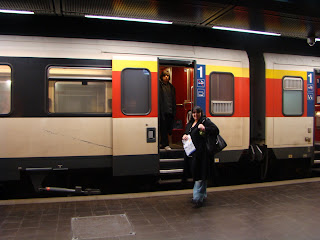 our luggage and then boarding the complimentary public transport into the centre of Geneva itself. When you arrive at the airport the free ticket you are provided with lasts for 90 minutes, however, all hotels in Geneva give visitors a pass which provides them with free public transport for the duration of their stay. This is great because Geneva is well stocked with trains, trams, buses, and ferries all of which fall under this provision. What we hadn’t counted upon was that, even though our hotel was only 16 kilometres from the centre of Geneva (they use kilometres in Europe, so we had to reconvert back from the miles to which we have become accustomed) it was across the Swiss border, in France, and so was not covered by this provision.
However, at this stage we hadn’t discovered this important fact and so, after arriving at Geneva’s Central Station, we boarded a tram out to Moillesulaz, a suburb of Geneva on the border with France. From there we walked across the border to get a taxi through Annemasse (the beautiful French town on the other side of the border) to Ville-le-Grand, which was the site of our hotel. Now because we were travelling to Switzerland and assuming that we would be spending most of our time there, the money that we had we had converted to Swiss Francs.
  Of course, now we were in France they would not accept these, only Euros would do, so before we could even get in the taxi we needed to get some more money. Once this was done our driver took a convoluted route to the hotel and charged us 3 times the amount he had originally quoted (taxi drivers are the same the world over it seems). It was at this point that we found out the news about public transport and Geneva not being applicable in France, which was a bit of a issue given that we had planned to use public transport to get back into Geneva and explore.
The hotel staff gave us some helpful directions and we were able to catch a bus not far away (although the walk was cold enough to have everyone rubbing their hands) and then a train from Annemasse Station back into a station near Parc La Grange on the edge of Lake Geneva. As you will see by the photos on our blog, Geneva is a beautiful city. There is a fascinating array of architecture with lots of monuments and streets dedicated to famous people. We jumped back on another tram (the ticket we had bought at the train station gave us travel for the remainder of the day) and went into the city centre to tour the shopping district and see what we could. After looking at the shops, we wandered down to the waterfront.
Although it was cold, windy and overcast, Lake Geneva was still a beautiful sight. It was only the wind being more obvious, and the lack of toilet facilities that drove us back into the city. However, there were so many parks and gardens in Geneva itself that this was not too much of a hardship. Among the many things we saw was a statue dedicated to Louis Favre, one of Geneva’s favourite sons. While it seems like a
  massive undertaking even now, imagine building a train tunnel through the Gotthard Massif (a mountain in between Switzerland and the Italian border) in 1872. When Wayne first travelled to Switzerland with his family back in 1982 they had travelled through the Road Tunnel, which had only been completed 2 years earlier) but he had not realised just how long the railway tunnel had been there. Sadly for Louis Favre he did not live to see the tunnel completed but died while still working on it one day in 1879. In this, he was among 200 who were killed while bringing about this feat of engineering.
Eventually, a toilet was found near an Anglican Church (which was a bit of a surprise to find in Geneva, particularly when we discovered that it was part of the Diocese of Gibraltar). However, when Meg, Brock and Quinn descended the steps (the toilets were underground) it transpired that only the men’s facilities were opened. Consequently, we continued to wander the streets for a period longer looking for somewhere for Meg to gain relief. This gave us the opportunity to travel the
  Rue Rousseau named for another famous Genevan, Jean-Jacques Rousseau. Rousseau was a major philosopher, writer, and composer during the Enlightenment, whose political philosophy influenced the French Revolution and the development of liberal, conservative, and socialist theory. His writings and music were also highly influential, but as it was getting late in the day (and no bathroom was to be found) we decided to return to Ville-le-Grand and Meg remained p
 hilosophical.

 thing, our extended families were not going to be there. For another, the weather promised to be somewhat colder (although Wayne vividly remembers being very cold at Lorne a couple of years ago). We were faced with a couple of options; try and recreate an Australian Christmas in the middle of England, or, go the whole hog and have a Christmas that was totally unlike any that we had ever had before. Without too much debate it was on the latter course that we decided and, consequently, on December 23rd we found ourselves waking at 3:10am ready for a 4am drive to Luton Airport.
None of us had ever been to Luton Airport before, although we had all seen it on the
 television program ‘Airport’ which was shown on television in Australia before we left. After dropping off Madge (our Nissan Almera that replaced Kylie the Mazda 323 after our trip to Manchester) at the airport parking, the bus took us up to the airport which, even at this early hour of the morning, was thronged with people. We had learned our lesson from our Madrid trip and were there in good time, even so, by the time we made the front of the queue they were putting out a last call for our flight. Once again, Meg and Wayne had kept the destination from the boys however, even when they read where we were going Brock identified it as Genovia and Quinn had no idea where Geneva was (so much for that excellent Geography mark!).
The flight itself seemed remarkably short, even to Meg who was the only one who didn’t sleep, a
 point which she still reminds the others about. She claims that this negates our previous status as ‘delightful travelling companions’, the boys assert that they had not had very much sleep and so needed a nap and that it is not their fault that Meg cannot sleep on aeroplanes. Coming into Geneva was amazing as we flew over the Alps, covered with snow and everybody was really excited about the possibilities that the next few days held.
On the ground, it was a matter of collecting
 our luggage and then boarding the complimentary public transport into the centre of Geneva itself. When you arrive at the airport the free ticket you are provided with lasts for 90 minutes, however, all hotels in Geneva give visitors a pass which provides them with free public transport for the duration of their stay. This is great because Geneva is well stocked with trains, trams, buses, and ferries all of which fall under this provision. What we hadn’t counted upon was that, even though our hotel was only 16 kilometres from the centre of Geneva (they use kilometres in Europe, so we had to reconvert back from the miles to which we have become accustomed) it was across the Swiss border, in France, and so was not covered by this provision.
However, at this stage we hadn’t discovered this important fact and so, after arriving at
 Geneva’s Central Station, we boarded a tram out to Moillesulaz, a suburb of Geneva on the border with France. From there we walked across the border to get a taxi through Annemasse (the beautiful French town on the other side of the border) to Ville-le-Grand, which was the site of our hotel. Now because we were travelling to Switzerland and assuming that we would be spending most of our time there, the money that we had we had converted to Swiss Francs.
  Of course, now we were in France they would not accept these, only Euros would do, so before we could even get in the taxi we needed to get some more money. Once this was done our driver took a convoluted route to the hotel and charged us 3 times the amount he had originally quoted (taxi drivers are the same the world over it seems). It was at this point that we found out the news about public transport and Geneva not being applicable in France, which was a bit of a issue given that we had planned to use public transport to get back into Geneva and explore.
The hotel staff gave us some helpful directions and we were able to catch a bus not far away
 (although the walk was cold enough to have everyone rubbing their hands) and then a train from Annemasse Station back into a station near Parc La Grange on the edge of Lake Geneva. As you will see by the photos on our blog, Geneva is a beautiful city. There is a fascinating array of architecture with lots of monuments and streets dedicated to famous people. We jumped back on another tram (the ticket we had bought at the train station gave us travel for the remainder of the day) and went into the city centre to tour the shopping district and see what we could. After looking at the shops, we wandered down to the waterfront.
Although it was cold, windy and overcast, Lake Geneva
 was still a beautiful sight. It was only the wind being more obvious, and the lack of toilet facilities that drove us back into the city. However, there were so many parks and gardens in Geneva itself that this was not too much of a hardship. Among the many things we saw was a statue dedicated to Louis Favre, one of Geneva’s favourite sons. While it seems like a
  massive undertaking even now, imagine building a train tunnel through the Gotthard Massif (a mountain in between Switzerland and the Italian border) in 1872. When Wayne first travelled to Switzerland with his family back in 1982 they had travelled through the Road Tunnel, which had only been completed 2 years earlier) but he had not realised just how long the railway tunnel had been there. Sadly for Louis Favre he did not live to see the tunnel completed but died while still working on it one day in 1879. In this, he was among 200 who were killed while bringing about this feat of engineering.
Eventually, a toilet was found near an Anglican
 Church (which was a bit of a surprise to find in Geneva, particularly when we discovered that it was part of the Diocese of Gibraltar). However, when Meg, Brock and Quinn descended the steps (the toilets were underground) it transpired that only the men’s facilities were opened. Consequently, we continued to wander the streets for a period longer looking for somewhere for Meg to gain relief. This gave us the opportunity to travel the
  Rue Rousseau named for another famous Genevan, Jean-Jacques Rousseau. Rousseau was a major philosopher, writer, and composer during the Enlightenment, whose political philosophy influenced the French Revolution and the development of liberal, conservative, and socialist theory. His writings and music were also highly influential, but as it was getting late in the day (and no bathroom was to be found) we decided to return to Ville-le-Grand and Meg remained p
 hilosophical.


