Wonderful, wonderful Copenhagen
Friendly old girl of a town
'Neath her tavern light
On this merry night
Let us clink and drink one down
To wonderful, wonderful Copenhagen
Salty old queen of the sea
Once I sailed away
But I'm home today
Singing Copenhagen, wonderful, wonderful
Copenhagen for me
‘Wonderful Copenhagen’ from the movie ‘Hans Christian Andersen’ starring Danny Kaye
Well, what do you do when you’ve finished a bus tour in beautiful Copenhagen, have had some lunch and have the rest of the afternoon ahead of you? No doubt some of you would go back and visit some of the attractions that you passed along the way, seeing them in a little more detail. Others might be inclined to head to the shopping district (it is a long mall between two of the main plazas) and while away the afternoon picking up souvenirs. We chose to go back to the train station to discover where else we might be able to go in Denmark. After all, Elsinore Castle from Shakespeare’s ‘Hamlet’ is just a short way up the coast and there are many other beautiful parts of Denmark to see. When we were investigating options at the train station we came up with an even better plan.
In late 1999 Crown Prince Frederik of Denmark and Crown Princess Victoria of Sweden met midway to celebrate the completion of the Øresund Bridge, linking the two countries across the Øresund Strait. It is actually a two track rail and four lane road bridge/tunnel and the longest border crossing bridge in the world. For the English equivalent of £20.60 in Danish Kroner the four of us were able to buy return tickets to Malmo in Sweden. Amazingly, the railway line goes under the traffic lanes on the bridge, then shares the tunnel for the last 4 kilometres. The bridge section actually ends on an artificial island in the Strait (called Peberholm). The island is more than 4 km long and a few hundred metres wide, belongs to Denmark and is now an unpopulated natural reserve.
What we didn’t realise when we boarded the train is that because of the Schengen Agreement between the two countries there is no passport control or customs, so we weren’t able to get extra stamps in our passports. While this was disappointing the notion of being able to just catch a train to another country (which we had done at Christmas between France and Switzerland) was so appealing we would have done it anyway. We are not the only ones, apparently, because house prices in Malmo are cheaper than in Copenhagen, Danes have been buying houses in Sweden and commuting to work. The train trip took very little time (just over half an hour) and was smooth and hassle free. Construction also finished 3 months ahead of schedule, no wonder Denmark frequently tops surveys of the best living standards in the world.
We have seen lots of wind turbines in our travels around Europe so far, but one of the interesting things we spotted as we crossed the bridge was a large number of them based in the Øresund Strait. This was one of Meg’s favourite sights of our trips so far, although she is not sure why it tickled her fancy so much. Possibly it was the contrast with England, where all the ones we have seen are on land and which generally draw protests about the impact both visually and environmentally that they have. Denmark was a pioneer in developing commercial wind power and currently 19.7% of their electricity is generated that way, the highest percentage of any country in the world.
Our first impression of Sweden was the station at Malmo which reminded us of the movie images of Platform 9 ¾ in the ‘Harry Potter’ films. When we walked off the platform and into the main terminal we noticed an automat where one could buy bunches of flowers, another sight which made Meg laugh. We wonder what the locals thought of these strange foreign people taking photos of their automats. Flowers are very common in this part of the world, with markets, stalls, shops and automated machines selling them everywhere. This led us to speculating on what species of flower would survive in the quite cold conditions we were experiencing.
Malmo is the third biggest city in Sweden, with almost 300 000 inhabitants and was one of the first in Scandinavia to become industrialized. However, for a long time it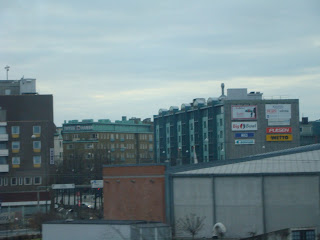 was actually Denmark’s second biggest city, having been part of that country until 1658 when the Treaty of Roskilde handed it over to the King of Sweden. Even then, the Danes weren’t completely satisfied, laying siege to the town for a month in 1677 but were unable to remove the Swedish troops guarding it. Today, it is one of the most multicultural cities in Scandinavia, with 171 different nationalities being represented among its population.
One of the first things that you notice when you leave the station and begin the walk into the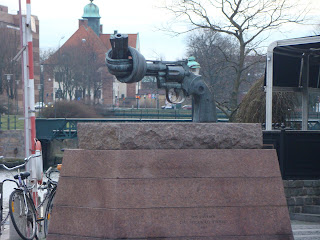 centre of Malmo is a statue of a gun with the muzzle twisted in a knot. It is apparently named ‘Non violence’ and was sculpted by Carl Fredrik Reuterswärd a Swede. Like so many iconic statues, there are multiple copies of this one, perhaps the most well known being that donated by the Government of Luxemburg to the United Nations which stands outside the United Nations building in New York. The artist was a friend of John Lennon and it was in response to Lennon’s murder that he came up with the concept.
Walking along the Centralplan into the Old Town (Gamla Staden) you very quickly reach the Stortorget (Main Square) which features an equestrian statue of King Charles X, the king who defeated the Danes and brought Malmo to the Swedish. Facing on to the square was the City Hall which was suitably old and impressive, but it was what was surrounding the Christmas Tree in the centre of the square which most excited us. Just as we had seen in Kongens Nytorv there was an ice-skating rink in the centre of the square.
  Quinn, in particular, just wanted to get out on the ice so, even though he didn’t have skates, he went for a walk (while Brock loudly expressed a desire that Quinn should slip and fall). A bronze sculpture on the site of the former city well also grabbed our interest, while Quinn successfully navigated himself among the young children and their watchful parents to the far side of the rink. It wasn’t as slippery as he had expected, was his report, possibly because it was still below freezing.
The pedestrianised streets which take you through the centre of Malmo are covered with beautiful cobblestones and some of the buildings similarly take you back in time. The City Hall, finished in 1546, now has a façade from the 1860s, when Helgo Zettervall redesigned it in the Dutch Renaissance style, much of which remains today. As far back as the 1500s, there was a restaurant in the City Hall cellar, where the Rådhuskällaren restaurant is located. Next door to the City Hall is the residence of the County Governor which was built in 17th century Renaissance style. Near this is the Kramer Hotel which was built in the 1870’s.
It was hard to know which way to look, there were little lanes which led through buildings to further courtyards and which were lined with shops, there were an enormous variety of different buildings, and there were also a plethora of statues and other works of art on the facades of buildings and on the streets around us. The funniest of these was a series of statues forming a little marching band walking up the street. It wasn’t clear if there was any larger purpose to their presence, but they certainly provided all the passers by with amusement.
At this point Meg and the boys wandered off into one of the many decorative homeware shops that seemed to be in this part of the city, while Wayne continued to mosey down the street taking photographs. Having taken a photograph of a quite beautiful building at the corner of a crossroads he wandered across to have a look at what sort of things might be sold there. Imagine his surprise to find R. M. Williams boots, shoes and belts featured in the window display (it was a shoe shop). In the midst of yet another country, it was fun to find a little bit of Australia.
Next up was the square named after King Gustav IV, who governed Sweden from Malmö during a period in the 19th century, Gustav Adolf’s Torg. Gustav IV planned to make Malmö the second capital city of Sweden, but was dethroned before he could carry out his vision. When we entered the square the first thing that took our notice was a large rally against the action taking place in Palestine at that time. It was quite large and noisy, and in places there were some very heated discussions going on. Not wanting to offend anybody we carefully walked through. The l
 atest redesign of the square took place in 1997, when a row of fountain sculptures were laid out and market trade became a permanent feature, and it was toward the markets that we now headed, however it seemed that a number of the traders were also connected to the protest so we moved on.
The next park of our walk took us across the ‘forstads canalen’ out of the old town of Malmo and into one of the newer sections of the city. Symbolic of this was the Malmo Hilton Hotel which we found directly in front of us. While not a particularly tall building by some cities standards, in a country where much of the land is quite flat, and a city where that is definitely the case, it towered above us. Indeed one of the hotels features which it
  uses to advertise is the fantastic views of the city, looking right out to the harbour and the bridge. Apparently the gym on the 20th floor is particularly impressive for this purpose. However, this isn’t the tallest building in Malmo, because in 2005 the Turning Torso was completed to give Malmo a skyline focus right on the waterfront. While we didn’t get right up to it, the 190 metre tall (easily twice as tall as any other building in the city) can be seen from almost anywhere, and is all private residences.
As it was now getting quite late in the day, and we had already determined that we would be eating dinner back in Copenhagen, we now proceeded to walk back to the train station. This involved us going past a couple of Wayne’s Coffee houses (that was what they were actually called, much to Wayne’s delight) and into a Lidl supermarket to see if we could pick up some drinks. In the end the queues were too long for Meg to bear (if you have ever shopped with her you will know what we mean) and we continued on our way without making a purchase.
One of the other things we noticed as we made our journey was that the fountains in Gustav Adolf’s Torg had been lit up with fires in the top bowl; that they managed to do this while still working as fountains was another impressive feat. The lateness of the hour (being the northern hemisphere the sun was rapidly setting at 4:30pm) had also put paid to the protest rally and the subsequent arguments, but it also seemed to have brought people out into the square to sit at open air cafes and restaurants. Oddly, it was now warmer with the sun setting that it had been during the earlier part of the afternoon.
Once again the trip across the bridge was quick and comfortable, despositing us back at Copenhagen Central Station with only a very short walk to our hotel. However, first we stopped at a local all-you-can-eat pizza bar which advertised dinner for 60 DKK per head (the equivalent of £7). We had been warned that Copenhagen would be very expensive, but this wasn’t too bad a deal (McDonalds meals in the UK are only a few pounds less). This might have had something to do with the economic downturn that has been affecting the world but, whatever the reason, it didn’t stop us eating our fill and then grabbing some drinks on the way back to the hotel for a relaxing night after another fabulous day.
The next morning saw us getting a good rest then up and to the train station for breakfast at McDonalds before enquiring if there was the possibility of another trip somewhere on the train. Hamburg (in Germany) we were told was an option and relatively cheap, however, the length of time it would take to get there and back would leave us pushing the boundaries of making our flight home. If we had only thought of this the day before we could have done Hamburg that day, and then Malmo on the Sunday (in retrospect we could have still gone to Hamburg, but you will have to read on to find out why). Outside the station there were still hundreds of pushbikes, so we theorised that many commuters leave them parked at the station over the weekend and during the night, unlocking them after their train trip in the mornings to cycle to work and then back in the afternoons.
The disappointment of not being able to catch another train meant getting up and walking back to the Rådhuspladsen. Despite the fact that it was colder (the thermometer informed us that it was -3°C) there were a few more people around this morning. Some of this might have been because the shops were open once again, as they are on the fourth Sunday of every month. Sadly, this didn’t mean that Tivoli Gardens were open as it closes during the winter months and would not open again until April. This meant that the boys missed out on riding ‘The Demon’, which is apparently the biggest, fastest, and most terrifying rollercoaster in the whole of Scandinavia. Despite there not being a lot of room in the park, this travels above other attractions meaning that it could be added without other things having to be removed. However, although it was closed, there were shops that were open and this gave Meg the chance to browse and to buy the boys some shirts.
Instead of going to the Tivoli and ‘The Demon’ (and secretly we believe the boys were relieved) we journeyed next to the Palace Hotel to the Hans Christian Anderson Museum and the Ripley’s Believe It Or Not Museum. These two exhibitions are separate but share a building space and it is possible to buy a reduced ticket to both. However, for time reasons when given the choice of one or the other, Brock and Quinn elected Ripley’s. There are 68 of these museums worldwide (including one in London) so it may be that you have come across one before. If not, they feature a series of displays (some of which are interactive) which give details of strange and unusual; practices, events, geological features, human forms, animals and other things found throughout the world. The museum also serves to give a bit of a biography of Ripley himself, so it was quite fascinating in places.
After this we moved just down the road a little way to the Museum and Gallery we had heard so much about the day before, the Ny Carlsberg Glyptotek. The collection is built around the personal collection of the son of the founder of the Carlsberg Breweries, Carl Jacobsen (1842-1914) the same gentleman who commissioned ‘The Little Mermaid’, but this is much more impressive. Meg, in particular, was excited at the prospect of seeing some paintings by Gauguin of which the Glyptotek has an impressive collection. This is largely because Gauguin married a Danish woman (Mette Sofie Gad) and lived in Fredericksburg for a winter. He had 9 children with Mette, so there are numerous descendants still living in Denmark (including well known musicians, painters and tv presenters apparently).
Before we even got to the collection of French paintings we were overwhelmed by the Winter Garden in the centre of the building, with the collection of sculpture that is stored there. As well there were fascinating collections of ancient Mediterranean artifacts, so one was able to move through the history of different empires, looking at actual statues, fragments of pottery, and whole sections of buildings with murals etc. Some of these are up to 5 000 years old and it is just awe inspiring to think that people were using the implements in front of us that long ago. If such a collection were touring Australia we would pay a fortune to see it, but because we were at it’s home, we were admitted free of charge.
As good as these other exhibitions were, the paintings (and sculptures) of the French Impressionists which we had come to see topped everything. Here were paintings that Meg and Wayne had heard of (and many that we hadn’t because they aren’t in more prominent galleries) which were awesomely good. All four of us played a game where each had to pick their favourite piece in each room and then explain why that particular piece appealed. While everyone got into the spirit, there were a number of rooms where each of us found it impossible to make just one choice. If you have a chance to visit this Museum, please do, otherwise their website is also worth a visit.
After the Glyptotek it was about 4pm which meant that we had time to go back to our new favourite pizza parlour, because the lunchtime special ran till 5 and was 10 DKK cheaper than the evening version. While we were there a waiter made the sad mistake of trying to take our plates away before he had finished. Both Brock and Wayne saw this as a personal affront and were determined to eat as much as they could before we left to go and pick up our bags (which the wonderful people at the Norlandia Star had allowed us to store during the day). The actual amounts that they ate are uncertain because Wayne had both chick pea and green salad with his pizza, suffice it to say that Wayne ate more than Brock and that both ate more than they would have if the waiter had not been rude.
Our flight was due to leave at 9:30pm but we reasoned that we might be able to get out early and either catch an early flight or at least book our bags in. Unfortunately, EasyJet had not opened their counters as yet, so we had a longish wait in Departures (where they even closed the coffee shop before 8:30 when our desk opened for check in. Eventually, however, we were checked in and through Customs into the proper Departure lounge ready to fly, just waiting for our Boarding Gate to come up on the screen. As the minutes ticked by and flights that were due to leave after us had been posted but ours had not we made enquiries as to what was going on. The forecast snow had hit England even more heavily that predicted and this had delayed the flight coming out which would provide the aircraft for our trip back.
After numerous delays, and some considerable frustration on behalf of many of the other passengers (perhaps we are learning some patience from the amount of travelling we have now done) we were eventually able to board around 11pm. This reminded us of one of the negatives associated with these low cost airlines, no assigned seating. The delays and concerns meant that many of our fellow passengers were quite wound up and pushing and shoving to get on to the aircraft. Ultimately, all four of us got seats in the second last row, with a group of boys/men sitting around us who had been participating in a skateboarding tournament and who were quite hyperactive. While this initially seemed like it might be a negative, it turned out to be better than we had hoped.
Once on the aircraft we were informed that we were not actually allowed to depart, because there was no certainty of somewhere to land at Stansted. Indeed, Gatwick and Luton airports had already been closed because of the amount of snow. It was here that the guys around us came into their own, telling stories and inviting others to do so (Quinn even demonstrated some bizarre things he can do with his body). Eventually, we made it into the air, but halfway home were told that Stansted had now also been closed and we were going to be diverted. Would it be Birmingham? Heathrow? Bristol? even, Aberdeen? No, we were going to be arriving at midnight in, of all places given our history, Manchester.
Once on the ground there everything about our last trip to Manchester seemed to be coming back to haunt us. We were kept on board the aircraft, partially in case, we were told, Stansted was able to reopen, until 3am. When we were finally allowed to disembark we were going to be put on to coaches headed back to Stansted (normally a 3 hour drive). Because of our position at the back of the aeroplane, we missed out on seats on the first two coaches and had to wait at the Terminal at Manchester for a third to be procured. Eventually, at 3:30am we were loaded on board and began the trek home, but the nightmare was not over.
Instead of 3 hours, because of the snow (and also the bizarre route and stops that our driver made) we did not arrive back at Stansted until close to 10:30am. The positive from this was that, because we had been on the final coach everybody actually got seats to themselves which made it possible for some (little) sleep to be enjoyed. While travelling Meg phoned the school to inform them that we would possibly be a little late. After initially being told that the school was open, and being rebuked for being so foolhardy as to be in a position to be late, we were then informed that the whole area was covered in thick snow and hence the school was closed, but that we were still expected to attend.
Wayne did not particularly enjoy the drive back from Stansted to home, especially when the car lost traction and drove into a snow drift despite his attempts to right it. However, we all enjoyed seeing the enormous quantities of snow which had been dumped on South East England. It was light, it was fluffy, and it was very thick. Meg still describes it as being like a ‘Disney Movie’. When we finally reached Hailey Hall we discovered two of our work colleagues building an igloo in the centre of the football pitch, a scheme which Quinn very happily participated in. While it wasn’t quite what we expected, even the negative aspects of this holiday had a silver lining (although none of us ever wants to go to Manchester again).
‘Wonderful Copenhagen’ from the movie ‘Hans Christian Andersen’ starring Danny Kaye
Well, what do you do when you’ve finished a bus tour in beautiful Copenhagen, have had some
 lunch and have the rest of the afternoon ahead of you? No doubt some of you would go back and visit some of the attractions that you passed along the way, seeing them in a little more detail. Others might be inclined to head to the shopping district (it is a long mall between two of the main plazas) and while away the afternoon picking up souvenirs. We chose to go back to the train station to discover where else we might be able to go in Denmark. After all, Elsinore Castle from Shakespeare’s ‘Hamlet’ is just a short way up the coast and there are many other beautiful parts of Denmark to see. When we were investigating options at the train station we came up with an even better plan.
In late 1999 Crown Prince Frederik of Denmark and Crown Princess Victoria of Sweden
 met midway to celebrate the completion of the Øresund Bridge, linking the two countries across the Øresund Strait. It is actually a two track rail and four lane road bridge/tunnel and the longest border crossing bridge in the world. For the English equivalent of £20.60 in Danish Kroner the four of us were able to buy return tickets to Malmo in Sweden. Amazingly, the railway line goes under the traffic lanes on the bridge, then shares the tunnel for the last 4 kilometres. The bridge section actually ends on an artificial island in the Strait (called Peberholm). The island is more than 4 km long and a few hundred metres wide, belongs to Denmark and is now an unpopulated natural reserve.
What we didn’t realise when we boarded the train is that because of the Schengen Agreement
 between the two countries there is no passport control or customs, so we weren’t able to get extra stamps in our passports. While this was disappointing the notion of being able to just catch a train to another country (which we had done at Christmas between France and Switzerland) was so appealing we would have done it anyway. We are not the only ones, apparently, because house prices in Malmo are cheaper than in Copenhagen, Danes have been buying houses in Sweden and commuting to work. The train trip took very little time (just over half an hour) and was smooth and hassle free. Construction also finished 3 months ahead of schedule, no wonder Denmark frequently tops surveys of the best living standards in the world.
We have seen lots of wind turbines in our travels around Europe so far, but one of the
 interesting things we spotted as we crossed the bridge was a large number of them based in the Øresund Strait. This was one of Meg’s favourite sights of our trips so far, although she is not sure why it tickled her fancy so much. Possibly it was the contrast with England, where all the ones we have seen are on land and which generally draw protests about the impact both visually and environmentally that they have. Denmark was a pioneer in developing commercial wind power and currently 19.7% of their electricity is generated that way, the highest percentage of any country in the world.
Our first impression of Sweden was the station at Malmo which reminded us of the movie
 images of Platform 9 ¾ in the ‘Harry Potter’ films. When we walked off the platform and into the main terminal we noticed an automat where one could buy bunches of flowers, another sight which made Meg laugh. We wonder what the locals thought of these strange foreign people taking photos of their automats. Flowers are very common in this part of the world, with markets, stalls, shops and automated machines selling them everywhere. This led us to speculating on what species of flower would survive in the quite cold conditions we were experiencing.
Malmo is the third biggest city in Sweden, with almost 300 000 inhabitants and was one of the first in Scandinavia to become industrialized. However, for a long time it
 was actually Denmark’s second biggest city, having been part of that country until 1658 when the Treaty of Roskilde handed it over to the King of Sweden. Even then, the Danes weren’t completely satisfied, laying siege to the town for a month in 1677 but were unable to remove the Swedish troops guarding it. Today, it is one of the most multicultural cities in Scandinavia, with 171 different nationalities being represented among its population.
One of the first things that you notice when you leave the station and begin the walk into the
 centre of Malmo is a statue of a gun with the muzzle twisted in a knot. It is apparently named ‘Non violence’ and was sculpted by Carl Fredrik Reuterswärd a Swede. Like so many iconic statues, there are multiple copies of this one, perhaps the most well known being that donated by the Government of Luxemburg to the United Nations which stands outside the United Nations building in New York. The artist was a friend of John Lennon and it was in response to Lennon’s murder that he came up with the concept.
Walking along the Centralplan into the Old
 Town (Gamla Staden) you very quickly reach the Stortorget (Main Square) which features an equestrian statue of King Charles X, the king who defeated the Danes and brought Malmo to the Swedish. Facing on to the square was the City Hall which was suitably old and impressive, but it was what was surrounding the Christmas Tree in the centre of the square which most excited us. Just as we had seen in Kongens Nytorv there was an ice-skating rink in the centre of the square.
  Quinn, in particular, just wanted to get out on the ice so, even though he didn’t have skates, he went for a walk (while Brock loudly expressed a desire that Quinn should slip and fall). A bronze sculpture on the site of the former city well also grabbed our interest, while Quinn successfully navigated himself among the young children and their watchful parents to the far side of the rink. It wasn’t as slippery as he had expected, was his report, possibly because it was still below freezing.
The pedestrianised streets which take you through the centre of Malmo are covered
 with beautiful cobblestones and some of the buildings similarly take you back in time. The City Hall, finished in 1546, now has a façade from the 1860s, when Helgo Zettervall redesigned it in the Dutch Renaissance style, much of which remains today. As far back as the 1500s, there was a restaurant in the City Hall cellar, where the Rådhuskällaren restaurant is located. Next door to the City Hall is the residence of the County Governor which was built in 17th century Renaissance style. Near this is the Kramer Hotel which was built in the 1870’s.
It was hard to know which way to look, there
 were little lanes which led through buildings to further courtyards and which were lined with shops, there were an enormous variety of different buildings, and there were also a plethora of statues and other works of art on the facades of buildings and on the streets around us. The funniest of these was a series of statues forming a little marching band walking up the street. It wasn’t clear if there was any larger purpose to their presence, but they certainly provided all the passers by with amusement.
At this point Meg and the boys wandered off
 into one of the many decorative homeware shops that seemed to be in this part of the city, while Wayne continued to mosey down the street taking photographs. Having taken a photograph of a quite beautiful building at the corner of a crossroads he wandered across to have a look at what sort of things might be sold there. Imagine his surprise to find R. M. Williams boots, shoes and belts featured in the window display (it was a shoe shop). In the midst of yet another country, it was fun to find a little bit of Australia.
Next up was the square named after King Gustav
 IV, who governed Sweden from Malmö during a period in the 19th century, Gustav Adolf’s Torg. Gustav IV planned to make Malmö the second capital city of Sweden, but was dethroned before he could carry out his vision. When we entered the square the first thing that took our notice was a large rally against the action taking place in Palestine at that time. It was quite large and noisy, and in places there were some very heated discussions going on. Not wanting to offend anybody we carefully walked through. The l
 atest redesign of the square took place in 1997, when a row of fountain sculptures were laid out and market trade became a permanent feature, and it was toward the markets that we now headed, however it seemed that a number of the traders were also connected to the protest so we moved on.
The next park of our walk took us across the ‘forstads canalen’ out of the old town of Malmo and
 into one of the newer sections of the city. Symbolic of this was the Malmo Hilton Hotel which we found directly in front of us. While not a particularly tall building by some cities standards, in a country where much of the land is quite flat, and a city where that is definitely the case, it towered above us. Indeed one of the hotels features which it
  uses to advertise is the fantastic views of the city, looking right out to the harbour and the bridge. Apparently the gym on the 20th floor is particularly impressive for this purpose. However, this isn’t the tallest building in Malmo, because in 2005 the Turning Torso was completed to give Malmo a skyline focus right on the waterfront. While we didn’t get right up to it, the 190 metre tall (easily twice as tall as any other building in the city) can be seen from almost anywhere, and is all private residences.
As it was now getting quite late in the day, and we had already determined that we would be eating dinner back in Copenhagen, we now proceeded to walk back to the train
 station. This involved us going past a couple of Wayne’s Coffee houses (that was what they were actually called, much to Wayne’s delight) and into a Lidl supermarket to see if we could pick up some drinks. In the end the queues were too long for Meg to bear (if you have ever shopped with her you will know what we mean) and we continued on our way without making a purchase.
One of the other things we noticed as we
 made our journey was that the fountains in Gustav Adolf’s Torg had been lit up with fires in the top bowl; that they managed to do this while still working as fountains was another impressive feat. The lateness of the hour (being the northern hemisphere the sun was rapidly setting at 4:30pm) had also put paid to the protest rally and the subsequent arguments, but it also seemed to have brought people out into the square to sit at open air cafes and restaurants. Oddly, it was now warmer with the sun setting that it had been during the earlier part of the afternoon.
Once again the trip across the bridge was quick and comfortable, despositing us back at
 Copenhagen Central Station with only a very short walk to our hotel. However, first we stopped at a local all-you-can-eat pizza bar which advertised dinner for 60 DKK per head (the equivalent of £7). We had been warned that Copenhagen would be very expensive, but this wasn’t too bad a deal (McDonalds meals in the UK are only a few pounds less). This might have had something to do with the economic downturn that has been affecting the world but, whatever the reason, it didn’t stop us eating our fill and then grabbing some drinks on the way back to the hotel for a relaxing night after another fabulous day.
The next morning saw us getting a good rest then up and to the train station for breakfast
 at McDonalds before enquiring if there was the possibility of another trip somewhere on the train. Hamburg (in Germany) we were told was an option and relatively cheap, however, the length of time it would take to get there and back would leave us pushing the boundaries of making our flight home. If we had only thought of this the day before we could have done Hamburg that day, and then Malmo on the Sunday (in retrospect we could have still gone to Hamburg, but you will have to read on to find out why). Outside the station there were still hundreds of pushbikes, so we theorised that many commuters leave them parked at the station over the weekend and during the night, unlocking them after their train trip in the mornings to cycle to work and then back in the afternoons.
The disappointment of not being able to catch another train meant getting up and walking back
 to the Rådhuspladsen. Despite the fact that it was colder (the thermometer informed us that it was -3°C) there were a few more people around this morning. Some of this might have been because the shops were open once again, as they are on the fourth Sunday of every month. Sadly, this didn’t mean that Tivoli Gardens were open as it closes during the winter months and would not open again until April. This meant that the boys missed out on riding ‘The Demon’, which is apparently the biggest, fastest, and most terrifying rollercoaster in the whole of Scandinavia. Despite there not being a lot of room in the park, this travels above other attractions meaning that it could be added without other things having to be removed. However, although it was closed, there were shops that were open and this gave Meg the chance to browse and to buy the boys some shirts.
Instead of going to the Tivoli and ‘The Demon’ (and secretly we believe the boys were
 relieved) we journeyed next to the Palace Hotel to the Hans Christian Anderson Museum and the Ripley’s Believe It Or Not Museum. These two exhibitions are separate but share a building space and it is possible to buy a reduced ticket to both. However, for time reasons when given the choice of one or the other, Brock and Quinn elected Ripley’s. There are 68 of these museums worldwide (including one in London) so it may be that you have come across one before. If not, they feature a series of displays (some of which are interactive) which give details of strange and unusual; practices, events, geological features, human forms, animals and other things found throughout the world. The museum also serves to give a bit of a biography of Ripley himself, so it was quite fascinating in places.
After this we moved just down the road a little way to the Museum and Gallery we had heard so
 much about the day before, the Ny Carlsberg Glyptotek. The collection is built around the personal collection of the son of the founder of the Carlsberg Breweries, Carl Jacobsen (1842-1914) the same gentleman who commissioned ‘The Little Mermaid’, but this is much more impressive. Meg, in particular, was excited at the prospect of seeing some paintings by Gauguin of which the Glyptotek has an impressive collection. This is largely because Gauguin married a Danish woman (Mette Sofie Gad) and lived in Fredericksburg for a winter. He had 9 children with Mette, so there are numerous descendants still living in Denmark (including well known musicians, painters and tv presenters apparently).
Before we even got to the collection of French paintings we were overwhelmed by the Winter Garden in the centre of the building, with the collection of sculpture that is stored there. As well there were fascinating collections of ancient Mediterranean artifacts, so one was able to move through the history of different empires, looking at actual statues, fragments of pottery, and whole sections of buildings with murals etc. Some of these are up to 5 000 years old and it is just awe inspiring to think that people were using the implements in front of us that long ago. If such a collection were touring Australia we would pay a fortune to see it, but because we were at it’s home, we were admitted free of charge.
As good as these other exhibitions were, the paintings (and sculptures) of the French Impressionists which we had come to see topped everything. Here were paintings that Meg and Wayne had heard of (and many that we hadn’t because they aren’t in more prominent galleries) which were awesomely good. All four of us played a game where each had to pick their favourite piece in each room and then explain why that particular piece appealed. While everyone got into the spirit, there were a number of rooms where each of us found it impossible to make just one choice. If you have a chance to visit this Museum, please do, otherwise their website is also worth a visit.
After the Glyptotek it was about 4pm which meant that we had time to go back to our
 new favourite pizza parlour, because the lunchtime special ran till 5 and was 10 DKK cheaper than the evening version. While we were there a waiter made the sad mistake of trying to take our plates away before he had finished. Both Brock and Wayne saw this as a personal affront and were determined to eat as much as they could before we left to go and pick up our bags (which the wonderful people at the Norlandia Star had allowed us to store during the day). The actual amounts that they ate are uncertain because Wayne had both chick pea and green salad with his pizza, suffice it to say that Wayne ate more than Brock and that both ate more than they would have if the waiter had not been rude.
Our flight was due to leave at 9:30pm but we reasoned that we might be able to get out early and either catch an early flight or at least book our bags in. Unfortunately, EasyJet had not opened their counters as yet, so we had a longish wait in Departures (where they even closed the coffee shop before 8:30 when our desk opened for check in. Eventually, however, we were checked in and through Customs into the proper Departure lounge ready to fly, just waiting for our Boarding Gate to come up on the screen. As the minutes ticked by and flights that were due to leave after us had been posted but ours had not we made enquiries as to what was going on. The forecast snow had hit England even more heavily that predicted and this had delayed the flight coming out which would provide the aircraft for our trip back.
After numerous delays, and some considerable frustration on behalf of many of the
 other passengers (perhaps we are learning some patience from the amount of travelling we have now done) we were eventually able to board around 11pm. This reminded us of one of the negatives associated with these low cost airlines, no assigned seating. The delays and concerns meant that many of our fellow passengers were quite wound up and pushing and shoving to get on to the aircraft. Ultimately, all four of us got seats in the second last row, with a group of boys/men sitting around us who had been participating in a skateboarding tournament and who were quite hyperactive. While this initially seemed like it might be a negative, it turned out to be better than we had hoped.
Once on the aircraft we were informed that we were not actually allowed to depart, because
 there was no certainty of somewhere to land at Stansted. Indeed, Gatwick and Luton airports had already been closed because of the amount of snow. It was here that the guys around us came into their own, telling stories and inviting others to do so (Quinn even demonstrated some bizarre things he can do with his body). Eventually, we made it into the air, but halfway home were told that Stansted had now also been closed and we were going to be diverted. Would it be Birmingham? Heathrow? Bristol? even, Aberdeen? No, we were going to be arriving at midnight in, of all places given our history, Manchester.
Once on the ground there everything about our last trip to Manchester seemed to be
 coming back to haunt us. We were kept on board the aircraft, partially in case, we were told, Stansted was able to reopen, until 3am. When we were finally allowed to disembark we were going to be put on to coaches headed back to Stansted (normally a 3 hour drive). Because of our position at the back of the aeroplane, we missed out on seats on the first two coaches and had to wait at the Terminal at Manchester for a third to be procured. Eventually, at 3:30am we were loaded on board and began the trek home, but the nightmare was not over.
Instead of 3 hours, because of the snow (and also the bizarre route and stops that our driver
 made) we did not arrive back at Stansted until close to 10:30am. The positive from this was that, because we had been on the final coach everybody actually got seats to themselves which made it possible for some (little) sleep to be enjoyed. While travelling Meg phoned the school to inform them that we would possibly be a little late. After initially being told that the school was open, and being rebuked for being so foolhardy as to be in a position to be late, we were then informed that the whole area was covered in thick snow and hence the school was closed, but that we were still expected to attend.
Wayne did not particularly enjoy the drive back from Stansted to home, especially when the
 car lost traction and drove into a snow drift despite his attempts to right it. However, we all enjoyed seeing the enormous quantities of snow which had been dumped on South East England. It was light, it was fluffy, and it was very thick. Meg still describes it as being like a ‘Disney Movie’. When we finally reached Hailey Hall we discovered two of our work colleagues building an igloo in the centre of the football pitch, a scheme which Quinn very happily participated in. While it wasn’t quite what we expected, even the negative aspects of this holiday had a silver lining (although none of us ever wants to go to Manchester again).


